
Orangeburg vs. Cast Iron vs. Clay Sewer Pipe
If your home was built before 1980, your sewer lateral is probably made from one of three materials: Orangeburg, clay, or cast iron. Each has its own strengths, weaknesses, and failure modes — and knowing which one you have tells you a lot about what to expect and when to act. This page compares all three.
Orangeburg Pipe
What It Is
Compressed layers of wood pulp and pitch (tar), pressed into tubes. Used primarily 1945–1972 as a cheap alternative during and after WWII when metal was scarce.
How It Fails
Orangeburg absorbs moisture, softens, deforms from round to oval, and eventually collapses. Failure is progressive — it doesn’t fail all at once. A pipe may deform for years before it collapses or causes a backup.
Expected Lifespan
Rated for 50 years at installation. Most Orangeburg in the ground today is 55–80 years old — well past that design life. Condition varies by soil moisture, installation quality, and traffic load above the pipe.
What to Do
A camera inspection determines current condition. Orangeburg that is still round may have some remaining life; Orangeburg that is deforming or collapsed needs replacement. There is no repair — only replacement.
Clay Pipe (Vitrified Clay)
What It Is
Fired clay pipe — essentially ceramic — used from the 1800s through the mid-20th century. Common in homes built before 1940 and some built into the 1950s. Often found in sections of Alexandria City, old Arlington neighborhoods, and the older parts of Falls Church and McLean.
How It Fails
Clay pipe itself is very durable — the clay doesn’t corrode or soften. But clay sewer joints are its weakness. The pipe is laid in short sections (typically 2 or 3 feet), and the joints between sections are a natural entry point for roots. Over decades, root intrusion at the joints is the primary failure mode for clay sewer lines. The pipe can also crack if soil settlement shifts the line or if heavy loads (vehicles, tree roots) bear down on it.
Expected Lifespan
Clay pipe that has been well maintained and has no significant root intrusion can last 100 years or more. Many clay lines installed in the 1930s and 1940s are still functioning today. But a clay line with heavy root intrusion may need cleaning annually and eventual replacement.
What to Do
Camera inspection reveals whether root intrusion is minor (manageable with cleaning) or extensive (replacement needed). Unlike Orangeburg, clay pipe doesn’t have an inevitable expiration — it can last indefinitely if the joints stay intact and roots stay out.
Cast Iron Pipe
What It Is
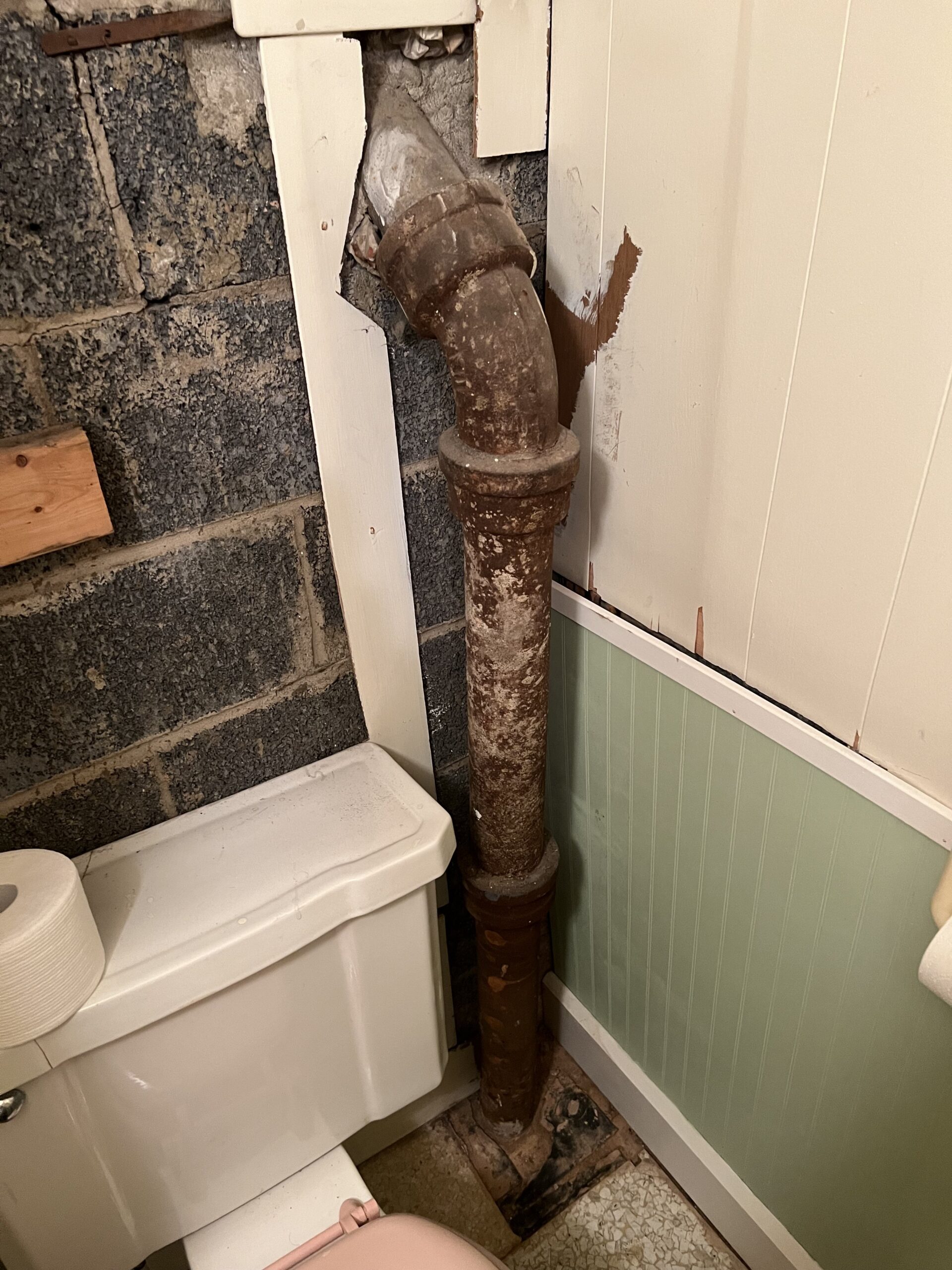
Heavy-wall iron pipe used from the late 1800s through the 1980s. Found both in interior drain lines (from the house) and in some sewer laterals, though it was more common as interior stack pipe than as the buried lateral line.
How It Fails
Cast iron corrodes from the inside out. The interior surface develops pitting and scale, which restricts flow and eventually causes failures. Hydrogen sulfide from sewage accelerates corrosion. Buried cast iron can also corrode from the outside in acidic soil. Failure typically looks like graphitization — the iron loses its strength while maintaining its shape, then cracks or collapses under load.
Expected Lifespan
Interior cast iron (drain stacks, fittings) typically lasts 80–100 years. Buried lateral cast iron is similar. Cast iron installed in the 1940s–1960s is reaching end of life. A camera inspection can reveal whether corrosion is affecting flow or structural integrity.
What to Do
Light surface corrosion on a functioning line may be monitored. Significant graphitization, internal scale buildup affecting flow, or cracks require repair or replacement.
Quick Comparison
Orangeburg: Most urgent — past design life, deteriorating, and replacement is inevitable. Camera inspection determines how soon.
Clay: Durable material with a root intrusion vulnerability. Can last very long if joints are intact. Camera inspection reveals root activity.
Cast iron: Long-lived but subject to internal corrosion over time. Approaching end of life in many pre-1970 homes. Camera inspection reveals corrosion level.
Get a Free Camera Inspection
Quality Sewer & Drain identifies all three materials and gives you an honest assessment of what you have and what — if anything — needs to happen next. Call (703) 686-7586 or book online.
